Coastal Design Education
Choosing Sofa Upholstery for Florida’s Humid, Sunlit Rooms
In Florida, a sofa’s fabric has a demanding brief: it should feel comfortable through warm, humid days, hold its color in rooms washed with sunlight, and remain graceful under the rhythms of everyday life. The smartest upholstery choice begins with how a room is used—not just how a swatch looks.
A beautiful sofa can anchor a living room, but its upholstery is asked to do more than complete a palette. It meets bare arms after an afternoon outdoors, bears the glow of broad windows, and absorbs the ordinary evidence of a home in motion. In Florida, where warmth and humidity are part of daily life and sunlight can be remarkably persistent, fabric selection deserves the same attention as silhouette and scale.
That does not mean a room must be designed around fear of fading or wear. Rather, it means looking beyond the first impression of a textile. Fiber content, weave, weight, finish, color, and care instructions each influence how upholstery feels and behaves. A considered choice can make a sofa more comfortable, easier to maintain, and more compatible with the light and climate of the space.
There is no single fabric that is ideal for every Florida home. A shaded apartment in a city building has different demands from a sunroom with west-facing windows; a household with pets or young children has different priorities from a rarely used formal sitting room. Begin with those real conditions, then choose upholstery that supports them with quiet confidence.
Start with the room, not the swatch
Before comparing fabrics, notice what the sofa will encounter. Track the light at several points in the day. Does direct sun cross the seat, or does the room receive bright but indirect daylight? Are the windows covered during peak afternoon hours? Is the sofa close to an entry where damp clothing, sand, or outdoor dust may arrive? These details are more useful than a general label such as “sunny room.”
Next, consider how the sofa will be used. A family-room sofa may see daily lounging and frequent cleaning; a guest-room loveseat may have a lighter workload. If people sit on the sofa in swimwear, or return from outdoor activities, quick-drying and easy-care qualities may matter more than a delicate hand. If the room is air-conditioned most of the time, the fabric’s tactile comfort may be more important than its performance in a fully open-air setting.
- Map the exposure: identify direct sun, reflected glare, and areas that stay shaded.
- Be honest about use: account for pets, children, entertaining, meals, and everyday lounging.
- Review the room’s air: ventilation and air-conditioning patterns influence comfort and drying.
- Set care expectations: choose a fabric whose cleaning routine feels realistic, not aspirational.
Breathability is a matter of touch and construction
A sofa’s comfort in a warm climate depends partly on how upholstery feels against the skin. Breathable fabrics can feel less clammy than dense, heat-retaining surfaces, particularly when the room is warm or the sofa is used for extended periods. The word “breathable,” however, is not a guarantee of performance by itself. Fiber, yarn, weave, backing, and any applied finish all contribute to the textile’s character.
Natural fibers such as cotton and linen are often valued for their familiar, relaxed hand. Their feel can be appealing in an airy interior, but the specific construction matters: a tightly woven, heavily backed cotton behaves differently from a light, open weave. Linen may have an elegant, lived-in texture, while also showing creases and wear in a way that some households enjoy and others find too informal. Neither fiber should be assumed to be inherently stain-proof, fade-proof, or low maintenance.
Synthetic and blended upholstery can offer practical advantages, depending on its construction and intended use. Some are designed to resist abrasion, repel certain spills, or simplify cleaning. Those claims should be checked against the manufacturer’s documentation rather than inferred from the fiber name. A blend may balance a soft hand with added durability, but there is no universal formula: a swatch and its care instructions tell a more useful story than a broad category.
When considering a fabric, ask whether it has a backing and how that changes the way it feels. A dense backing may affect breathability and drape. Also check whether the fabric’s finish is part of its performance story and whether that finish has specific care restrictions. In a Florida home, comfort is not an abstract technical feature; it is the first impression made every time someone sits down.
Weave and weight shape everyday performance
A close, stable weave can help upholstery resist snagging and abrasion, while a looser or more textured construction may bring visual depth and an inviting hand. Those qualities are not opposites, but they do involve trade-offs. A pronounced loop or open weave can catch claws or debris more readily; a smooth, tightly woven fabric may be easier to brush clean but feel more tailored than soft.
Fabric weight is another useful point of comparison, though heavier does not automatically mean better. A substantial textile may drape beautifully and feel reassuringly durable, but it can also retain more warmth. Lighter upholstery can feel breezier yet may be less suited to an intensively used sofa, depending on its construction. The right balance comes from matching the textile to the frame, cushion shape, and room’s daily use.
Look closely at the surface. Does the pile change direction when brushed? Is the texture likely to show pressure marks? Could a fine weave reveal pet hair or lint? Such considerations affect not only durability but the sofa’s appearance between cleanings. A tactile, dimensional fabric may be visually forgiving in one color and conspicuously marked in another.
A useful showroom test is to handle a generous fabric sample in natural light, if possible. Rub it gently between your fingers, press it against the inside of your wrist, and observe how it bends. Ask for an upholstery sample large enough to see the pattern repeat and texture clearly. A tiny swatch can make a complex weave appear uniform and can conceal how a color shifts across a larger surface.
Sunlight, fading, and the role of color
Bright rooms can make upholstery feel luminous, but sustained direct sun may alter some textiles over time. Colorfastness is the fabric’s ability to retain its color under conditions such as light exposure; it is a quality to verify with the supplier or manufacturer, not something that can be reliably judged by eye. Ask whether testing information is available and whether the fabric is recommended for rooms with significant sun exposure.
Color affects how a room reads, but no shade is automatically immune to fading. Pale neutrals may make gradual changes less conspicuous in some settings, while saturated colors can make an altered patch more noticeable. The result depends on the dye, fiber, weave, amount of exposure, and surrounding light. Choose a color you love, then protect it with sensible placement and window treatments rather than relying on color alone.
Pattern and texture can also soften the visual impact of everyday marks. A small-scale weave, subtle striation, or nuanced heathered color may disguise minor dust and variation better than a perfectly uniform surface. Yet the effect is individual: a high-contrast pattern can draw attention to seams, while a textured pile may show changes in direction. View samples at different times of day to understand how the color shifts from cool morning light to warmer afternoon sun.
Window coverings are among the most effective design tools for moderating direct exposure. Sheers can diffuse light while preserving a bright atmosphere; lined drapery or adjustable shades can provide stronger protection when the sun is intense. The aim is not to darken a room, but to control the hours and angles of direct light reaching the sofa. Rotating loose cushions periodically can help distribute exposure more evenly, where the design allows.
Care instructions are part of the design decision
Before committing to upholstery, read the cleaning guidance carefully. Some fabrics can be spot-cleaned with specific methods; others require professional treatment or have restrictions on water-based cleaners. A fabric that looks effortless may be demanding to maintain, while a more practical option can preserve a relaxed, polished room with less daily attention.
Do not assume that a removable cushion means the cover is washable. Covers may be intended for professional cleaning, and washing can cause shrinkage, color change, or distortion. Confirm what “cleanable” means for the exact fabric and configuration. If a slipcover is being considered, ask whether it is removable, how it should be cleaned, and whether the supplier recommends having a second cover for rotation.
For routine care, follow the maker’s directions rather than experimenting with household products. Vacuum upholstery using an appropriate attachment to remove dust and grit before it works into the weave. Blot spills promptly with a clean cloth; avoid aggressive rubbing, which may spread a stain or roughen the surface. Test any approved cleaner on an inconspicuous area first, and contact a professional when the care label recommends it.
- Keep the manufacturer’s care instructions with your household records.
- Use a vacuum attachment suited to upholstery and avoid excessive pressure.
- Blot spills instead of scrubbing, and use only approved cleaning methods.
- Ask whether cushion covers can be removed and what cleaning process is permitted.
- Allow damp upholstery to dry fully according to the maker’s guidance before use.
Humidity and the whole room environment
Humidity is often discussed as though it were a test that every sofa fabric passes or fails in the same way. In practice, the room’s overall conditions matter. Air circulation, temperature, sunlight, and how quickly a spill or damp surface dries all contribute to the experience of living with upholstery. A sofa placed in a well-ventilated, climate-controlled room has a different environment from one in a screened porch exposed to outdoor air.
Upholstered furniture intended for indoor use should not be treated as outdoor furniture simply because it is in Florida. Unless a manufacturer specifically states that a textile and frame are suitable for outdoor exposure, protect the sofa from rain, persistent dampness, and prolonged contact with wet items. When beach gear or damp clothing enters the home, keeping it off the upholstery is a straightforward way to reduce cleaning demands.
Good room planning can support the sofa’s longevity. Leave a little space around the piece for airflow, avoid pressing it directly against a damp exterior wall, and maintain ventilation appropriate to the home. If a room develops persistent dampness or condensation, address the underlying building or ventilation issue rather than expecting upholstery to compensate. Fabric selection is part of a thoughtful interior, not a substitute for a healthy indoor environment.
A coastal palette without the predictable clichés
Florida light invites a palette that feels fresh, but coastal design need not rely on a literal procession of nautical motifs. Warm whites, mineral grays, pale greens, sandy neutrals, and softened blues can suggest sea and sky without turning a living room into a set. The upholstery can become a quiet foundation, with color introduced through art, a rug, or washable accent textiles.
For a tailored effect, consider a restrained neutral sofa against natural wood and a few tactile accents. A textured cotton pillow cover, for example, can add dimension without requiring the entire sofa to carry a prominent pattern. The [Sea Ridge Organic Decorative Pillow Cover](/products/sea-ridge-organic-decorative-pillow-cover-3910) is made from certified organic cotton with a varied-yarn weave, an envelope closure, and a knife-edge finish. Its listed care is machine wash cold on a gentle cycle, with low tumble drying; check the full care guidance before use.
If the sofa itself is intended to be the room’s focal point, consider how the upholstery color relates to walls, flooring, and the direction of natural light. A cool gray can appear crisp in a bright room and subdued in shade; a warm beige may read golden by late afternoon. Choose a tone that remains attractive under the room’s actual lighting rather than selecting it under showroom lamps alone.
A practical framework for comparing fabric samples
When several upholstery options seem equally appealing, compare them systematically. Write down the properties that matter most, then assess each swatch against the same questions. This makes the decision less dependent on a fleeting first impression and helps reveal trade-offs that may otherwise be overlooked.
- Comfort: Does the fabric feel pleasant on bare skin in a warm room?
- Light exposure: Is its colorfastness appropriate for the sofa’s location?
- Construction: Is the weave suited to the household’s level of use?
- Maintenance: Are the cleaning instructions practical for your routine?
- Appearance: Does the texture and color still appeal in morning and afternoon light?
- Documentation: Can the seller clarify durability, cleaning, and performance claims?
Bring samples home and place them where the sofa will sit. Observe them near a window, beside the flooring, and against the wall color. Leave them in place for a few days rather than making a decision in a single visit. If possible, ask for a larger memo sample so that pattern scale and the interplay of light and texture are easier to judge.
Sofa form, upholstery, and everyday ease
Fabric is only one part of a sofa’s performance. Cushion construction, seams, seat configuration, and the presence of a slipcover influence how the piece feels and how easily it can be cared for. A bench seat creates a continuous visual line, while separate cushions can be rotated individually if the design permits. Neither arrangement is universally better; the practical question is how you prefer the sofa to look and maintain.
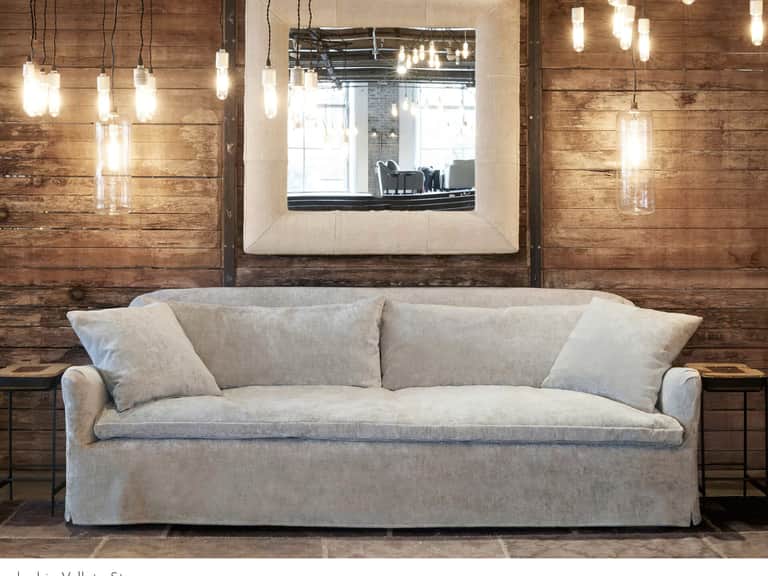
The Cisco Home Hazel Sofa offers a useful example of a design that connects upholstery choice with a relaxed living-room aesthetic. It has a bench-topper seat, two back cushions, and customizable upholstery options, as well as a slipcovered option according to its product details. The listed frame is FSC-certified hardwood with webbing support. Those details may help shoppers frame questions about fabric, care, and construction, but the specific upholstery’s performance still depends on the selected textile and its care documentation.
Before placing an order, clarify the exact fabric specification, color, cleaning code or care method, and whether any performance treatment is included. Confirm what the warranty covers and whether it excludes fading, staining, or damage caused by improper cleaning. A sofa is a long-term purchase; precise answers matter more than a broad description such as “durable” or “easy-care.”
The final choice: a fabric for the life you actually live
The most successful sofa upholstery in a Florida home is not necessarily the most technical, the palest, or the most expensive. It is the one whose feel, appearance, maintenance requirements, and light tolerance suit the room as it exists. That may mean choosing a breathable-feeling weave for a frequently used family room, a color with verified lightfastness for a bright window wall, or a slipcover that makes routine care more manageable.
Treat sunlight as a design element to manage, humidity as a feature of the room’s environment, and cleaning as a practical part of ownership. Ask specific questions, test samples in place, and make sure the care routine feels sustainable for your household. With those decisions settled, the sofa can do what it should: bring ease, character, and a sense of welcome to the room, without asking the upholstery to fight the climate alone.